The James C. Kennedy Wellness Center in Charleston recently hosted a special event celebrating its recognition as a “ripple of hope” in the late Dr. David K. Jones’ book, “Ripples of Hope in the Mississippi Delta: Charting the Health Equity Policy Agenda.”
Nearly 100 attendees gathered for the occasion, including faculty from the University of Mississippi, Tallahatchie General Hospital board members, Tallahatchie General Hospital Medical Foundation board members, community members, program participants, community partners, David’s mother and one of the book’s editors, Debra Bingham. Also present were Lynette Stafford and Kathryn Thompson, representatives from the Delta Foundation, another impactful organization featured in the book.
Linda Stringfellow, founder and executive director of FABRIC Inc., also present, was paramount in helping to organize and host the event.
The book, published posthumously, highlights transformative initiatives addressing health disparities in the Mississippi Delta.
Jones, a nationally respected health policy scholar, dedicated his work to understanding and promoting community-driven health solutions. His research underscores the Kennedy Wellness Center’s role as a model for improving health outcomes and fostering hope in rural communities.
The Mississippi Delta consistently ranks as having some of the worst health outcomes in the United States. Even with this stark reality, researcher Jones (1981–2021) found “ripples of hope.”
For four years, Jones turned to residents and local leaders to learn firsthand the intricate connections between race, place and health in the region. Using an innovative mix of photovoice, policy and social science research, Jones weaves their insights with data analysis to show how local, state and national policies and structures, whether or not intentional, constrain or expand daily choices that affect health.
Blaming individuals for poor health choices isn’t the remedy. Jones describes how a community-led, goal-oriented approach to creating health equity policies is needed and that everyone benefits when we ensure that all people can pursue a healthy, fulfilling life. In this compassionate and practical book, Jones provides a roadmap for anyone who would like to make a difference, wherever they live. Jones calls on his readers to act for change and provides examples from the Delta to show how. He reminds us that small steps — “ripples of hope” — can save lives and improve health.
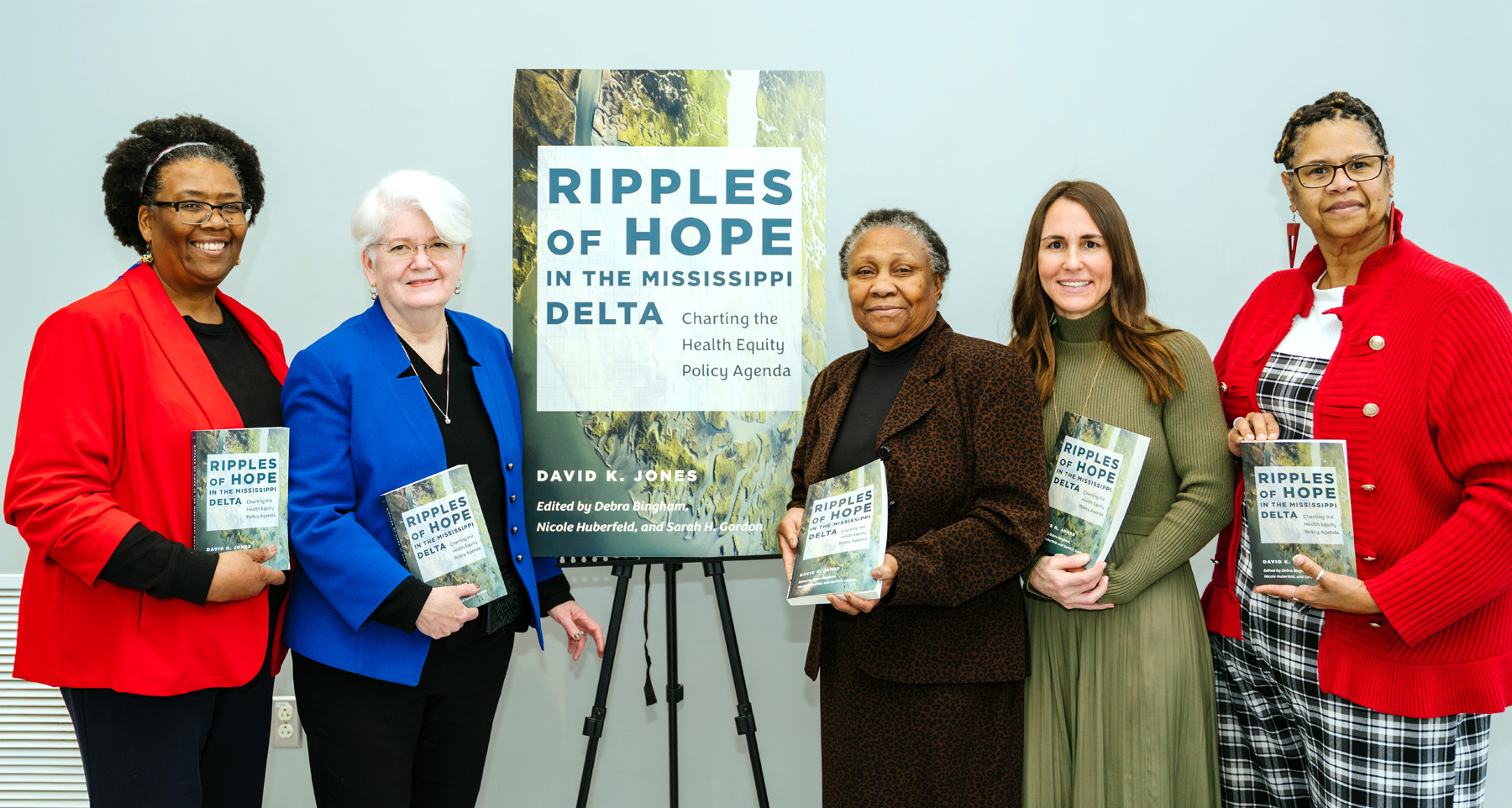 From left, Lynette Strafford, Debra Bingham (mother of "Ripples of Home" author David K. Jones), Katherine Thompson, Catherine Moring and Linda Stringfellow are pictured at a recent Wellness Center event. (Photo by At Your Best Photo/Rebekah Clayton)
During the event, attendees engaged in meaningful discussion about the book’s themes and the Wellness Center’s contributions to health and wellness in Tallahatchie County. The Kennedy Wellness Center, funded by a generous $4 million gift from philanthropist Jim Cox Kennedy, has become a cornerstone for preventive care, wellness programs, exercise and recreation, and chronic disease management in the region.
“This recognition is not just about the center; it’s about the people, the partnerships and the shared commitment to improving health in the Delta,” said Dr. Catherine Moring, who addressed the audience during the celebration. “Dr. Jones’ book shines a light on the powerful work happening in our community, and we are honored to be part of this movement.”
Moring, executive director of the Wellness Center in Charleston, emphasized that this recognition not only speaks to the work of the local center, but to the resilience, strength and determination of the community as well as the many partners and colleagues; it speaks to the decade of work and progress. She went on to say, “We live in a region that has long faced challenges — health disparities, economic hardship and barriers to health care access. But we also live in a place defined by hope, perseverance and the unwavering belief that we can create a better future. That belief is at the heart of why we do what we do.”
The Wellness Center is not just a facility; it is a movement. A movement that believes that good health should not be a privilege, but a right. That wellness is not just about treating illness, but about preventing it. That health care is not just about medicine, but about community, education and support.
Change is possible. The center’s staff see it every day. It is seen in the person who, through their programs, feels better and has a better outlook on life. In the grandparent who has the energy to play with their grandchildren again. In the mother or father who finds the strength to prioritize their health, knowing their children are watching.
The center is more than just a place — it is a beacon of hope. It is a reminder that where you live should not determine how long you live. It is proof that when a community comes together, we can rewrite the story of health in the Mississippi Delta.
The center’s impact is profound. Many people have improved their health conditions, regained their independence and found a support system they never had before. Attitudes have shifted from feeling helpless to feeling hopeful. Lives are changing, one step, one program, one person at a time.
Moring challenged those in attendance as well as the community when she said, “The truth is this work is not just the responsibility of the Wellness Center. This is about all of us. It’s about neighbors helping neighbors. It’s about businesses supporting wellness initiatives. It’s about families making health a priority.”
When Sen. Robert F. Kennedy Sr. spoke of “ripples of hope,” he reminded us that even the smallest actions can create waves of change. The Wellness Center and the Charleston community are part of that change.
The work of the center is not just about health care; it is about hope. And hope, when nurtured, spreads. So, let us, Moring said, continue to be those ripples of hope. Let us continue to build a healthier, stronger, and more equitable future — together.
The Delta Foundation, also featured in Ripples of Hope in the Mississippi Delta, was represented at the event, reinforcing the collaborative efforts that drive meaningful change in rural health care. The foundation’s mission is to provide community, social, human and economic development activities to underserved, mostly minority families, businesses and communities. This mission is undertaken to eliminate poverty within the Delta region.
The book’s new website, www.HealthEquityPolicy.com, was also on display at the event. Gregory Braggs, an award-winning website developer who grew up in and currently lives and works in the Delta, attended the event in person in order give participants a tour of the website. The website highlights key components of the book, including information about all of the 14 individuals, organizations and structures identified by Jones as “ripples of hope.”
The event concluded with reflections on the book’s impact and a renewed dedication to continuing the Wellness Center’s mission. Copies of “Ripples of Hope in the Mississippi Delta” were available for attendees, ensuring that Jones’ legacy and vision for health equity remain alive in the community. Moring ended her address to the audience with a quotation by Margaret Mead, “Never doubt that a small group of thoughtful, committed citizens can change the world; indeed, it’s the only thing that ever has.”
Sweet Sweet Eats, owned and operated by Charlestonian Stephanie Strider, provided a meal for all of the guests.
Photographs were taken by Rebekah Clayton, owner of At Your Best Photo.
For more information about James C. Kennedy Wellness Center programs, services, resources and amenities, visit www.jckwellness.com or call 662-625-7214.