With a $1 million earmark check from Congressman Bennie Thompson’s office in hand, Concetta Wells is excited that the Charleston Community Center soon will have a stable place to call home.
Since founding the center in 2018, while serving 56 children inside a small, one-bathroom building south of Charleston, Wells has seen the nonprofit move three times.
The center’s latest digs, leased since January, is a building at 368 George Payne Cossar Boulevard.
“I’ve had to bounce a whole lot, which is why this funding means a lot,” said Wells, 36, who holds the title of executive director.
Wells is looking to purchase land inside the Charleston city limits for construction of a permanent facility.
She envisions a large building with classrooms, a gymnasium and possibly even an indoor practice field for local youth baseball and football teams — “so those coaches would have somewhere for the kids to practice if it rains.”
The gymnasium could be utilized to host a wide range of community events, she said, similar to the complex housing the Tutwiler Community Education Center in Tutwiler.
"I love it!" Wells said of the Tutwiler facility. "Something like that, but for our area."
Currently, Wells is working with an Oxford architect to plan, design and oversee construction of the new center, and she is hopeful that the facility can be up and running “at least by the end of the year.”
— * —
The Charleston Community Center’s staff of three serves students from eastern Tallahatchie County through after-school tutoring, youth development programs and mentoring five days a week.
“We pick kids up every day from school,” said Wells, noting that they also offer meals.
The children have field trips and are transported in a van Wells purchased with her own funds to participate in a variety of educational activities at the Charleston Arts Center (CARE building).
— * —
Wells, a 2006 graduate of Charleston High School, has a doctorate in psychology.
“I started out in social work,” she explained. “Ever since I’ve been out of school, I’ve worked with families and kids. This is something that I’ve always enjoyed doing.”
After starting the community center — a mission given to her by God, she noted — Wells has found the going tough.
Now a teacher at the Eva Covington Head Start Center in Charleston, she devotes a good chunk of her paycheck to expenses of the community center, as she said she has done from the beginning.
“I just had to do what I had to do,” she explained.
Over the years, the center has received some private donations, including several grants from the Ed and Becky Meek Foundation, and is presently assisted by the Save the Children organization.
In 2022, she learned about Community Project Funding, earmarks awarded annually by members of Congress.
After contacting Thompson’s office, Wells received assistance and guidance through the application process. "His staff was really, really great," she noted.
“They told me the least amount I could apply for was $1 million,” she said. “I applied for that amount. I didn’t think I was going to get it.”
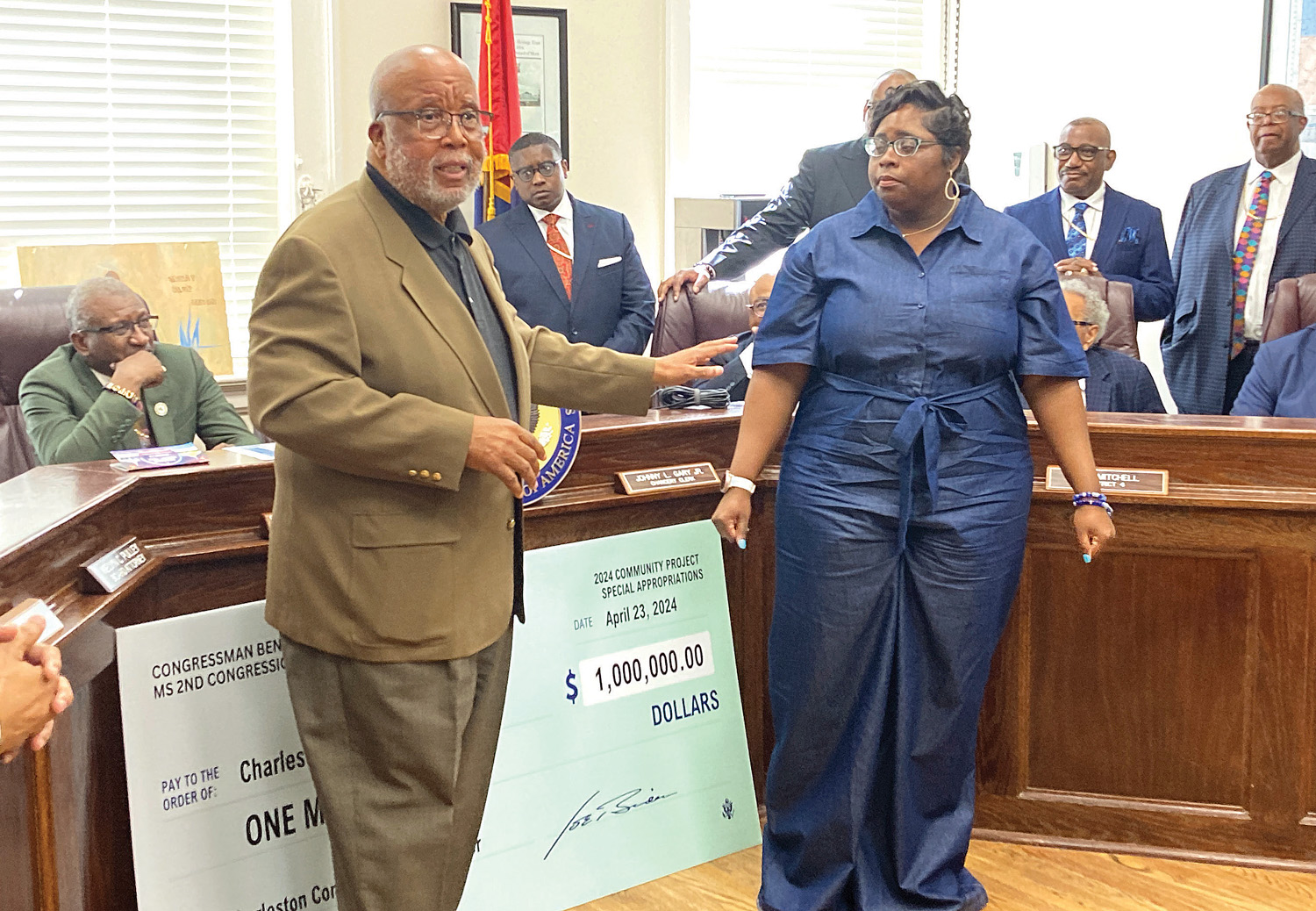 Second Congressional District Congressman Bennie Thompson speaks while standing alongside Concetta Wells of the Charleston Community Center during an April 23 press conference at the Leflore County Courthouse in Greenwood. (Photo by Susan Montgomery/Greenwood Commonwealth)
As part of the application process, letters of recommendation were required.
“I had great recommendation letters from TELA (Tallahatchie Early Learning Alliance), which I partner with; CARE; and Catherine Moring with the James C. Kennedy Wellness Center.”
The funds are a game-changer for the center, and affirmation of Wells’ faith.
During an April 23 press conference called by the congressman's office at the Leflore County Courthouse in Greenwood to announce this and five other Community Project Funding awards within the northern part of Thompson's 2nd Congressional District, an emotional Wells talked about her journey, sometimes with a voice that cracked and while wiping away tears.
"First of all, let me say to God be the glory!" Wells began. "When God gives you something, you have to run with it."
"I don't know how many times people told me to quit..." she said about the center.
"Do you know how many doors got slammed in my face?" she asked. "But I trusted God, and to God be the glory!"
"To God be the glory" was a refrain that she recited five times, stressing that this was God's process all along.
“It’s been a hard process — every bit of it has been hard — but it’s been worth it," she said.
In her closing remarks, Wells said, "Charleston Community Center in Charleston, Mississippi, is not big at all, but it's what God gave me. I trust the process. Thank you. To God be the glory!"
Speaking after Wells, Thompson said, “So, you heard the testimony. And so, I don't have to say anything else. You know, you kind of look around and see who needs help, and that's part of what we are trying to do. Sometimes we get opportunities, sometimes we don't. ... I know that this vision is going to make a difference in that community."
Thompson said Wells plans to use the money to "put a building up, to get the assets necessary to take care of these children, and make a difference in their lives. ... Those young people in Charleston and Tallahatchie County, their lives will never be the same after this. So, we’re so excited!”
Community Project Funding allows members of the U.S. House of Representatives to fund specific projects for state, local or tribal governmental grantees and certain eligible nonprofits. This year, Thompson earmarked nearly $13.824 million in Community Project Funding for 14 projects within his district.
Other awardees included Central Mississippi Inc., Leflore County Board of Supervisors, Town of Sledge, North Delta Mississippi Enterprise Community, Town of Sardis, Alcorn State University, Mississippi's Toughest Kids Foundation, COGIC (Church of God in Christ) Charities Inc., Community Students Learning Center, Kosciusko Foundation for Excellence in Education, Hope Enterprise Corporation, City of Natchez and Southwest Mississippi Planning and Development District.
Editor's note: This story is expanded from that published in the May 2 print edition, including more quotes and information.