ENID — No other date was even considered for Tuesday’s April 18 commemoration of an historical marker honoring a local war hero from the Greatest Generation.
Eighty years earlier, that very day — April 18, 1943 — a native of this small Tallahatchie County community had led a daring and unlikely to succeed military mission to kill the one man in the world perhaps most despised by Americans above any other.
Marshal Admiral Isoroku Yamamoto of the Imperial Japanese Navy had been architect and commander of the Japanese attack on Pearl Harbor on Dec. 7, 1941 — a sucker punch that killed 2,403 Americans, crippled the U.S. Navy’s Pacific fleet and thrust the country into World War II.
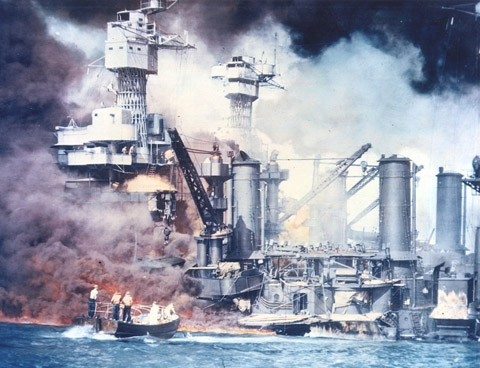 Thick smoke rolls out of a burning ship during the attack on Pearl Harbor by the Japanese, Dec. 7, 1941. (U.S. National Archives Public Domain)
Little more than a year later, 28-year-old Army Air Corps Maj. John William Mitchell of Enid would command a U.S. surprise attack on a Japanese flight group that would take Yamamoto out.
The mission was called “Operation Vengeance.”
— * —
A crowd of about two-dozen people was on hand Tuesday to celebrate the late Col. John William Mitchell — he was promoted before retirement — and to celebrate a new Mississippi Department of Archives and History marker erected on the east side of the railroad tracks, near Enid Depot store and restaurant.
Among those assembled was the honoree’s son, John William “Billy” Mitchell Jr. and his wife, Stacy, from Georgia.
Billy said his father, born June 14, 1914, to Noah Boothe Mitchell and Lillian Florence Dickinson Mitchell, lived in a house that stood only a few hundred yards north of the Enid Depot, near where the new cast aluminum marker resides as a prominent fixture.
It was in the Enid community where his dad first took to the skies, he explained.
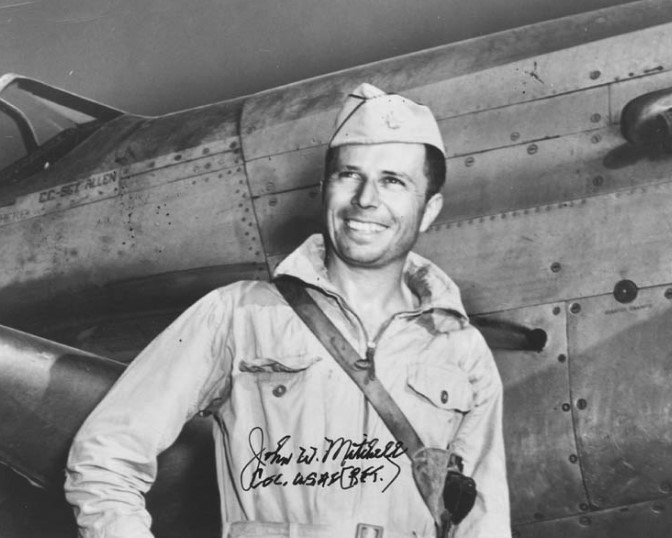 John William Mitchell. (Public Domain)
“What lit a fire under him for flying was when a barnstormer came around here and the pilot was selling rides for a buck fifty. My dad didn’t have $1.50, so he sweet-talked the clerk at the store [where his family had an account] to advance him the money. He paid the barnstormer, went out and flew, and after that he was done. He said ‘I’m going to fly.’”
Mitchell, Billy noted, would have gotten “a big kick” out of being honored with a state historical marker in the community of his birth.
“He’d be like, ‘This old hillbilly from Mississippi is getting one of these?’ He wouldn’t have believed it if you had told him that.”
— * —
Mitchell was more than deserving, according to those who offered remarks during a formal program Tuesday.
State Rep. Tommy Reynolds recounted that Mitchell, who had been valedictorian of his small graduating class at Enid High School and received a $500 scholarship to attend Columbia University in New York before joining the Army in 1934, was the epitome of America.
“The reason we’re here today in Enid, Mississippi, enjoying our freedom is because of John W. Mitchell and people like him,” Reynolds said. “He is an example that we ought to emulate and never, never forget.”
First, as an Army aviator in the Pacific, Mitchell shot down 11 Japanese aircraft during World War II. As a pilot in the Air Force during the Korean War, he also shot down four Russian MiGs flown by North Korea — for a total of 15 aerial combat victories in his career.
— * —
In April 1943, Mitchell, then a major, was stationed on Guadalcanal in the Solomon Islands and commanded the 339th Fighter Squadron of the U.S. Army Air Forces.
On April 14, American codebreakers intercepted and decrypted a Japanese message outlining a planned April 18, 1943, tour of Japanese-held South Pacific islands by Yamamoto, now commander-in-chief of the Combined Fleet. His first stop would be Bougainville Island at 10 a.m.
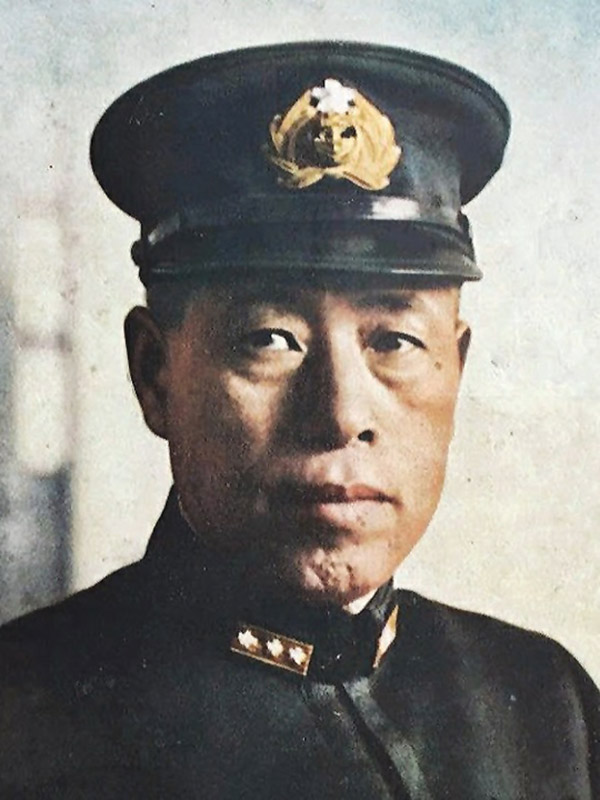 Japanese Marshal Admiral Isoroku Yamamoto (Public Domain)
Some unsubstantiated accounts suggest that when President Franklin D. Roosevelt was apprised of the message bearing the admiral’s itinerary, he ordered the shoot-down mission personally.
What history does record is that the message had been intercepted and translated, ironically, in Hawaii, after which it was passed on to Washington and bounced around to a few other people before reaching the command structure on Guadalcanal.
There, Mitchell was summoned to an important meeting of top military brass, where the ace fighter pilot learned that he had been hand-picked to help plan, coordinate and to command a targeted strike mission to kill the Japanese commander.
Operation Vengeance would be the longest USAAF planned intercept ever, and Mitchell himself gave it little chance of success. He estimated the odds of even spotting the Japanese flight group, much less shooting down Yamamoto’s plane, at 1 in 1,000.
Nonetheless, on the morning of April 18, Mitchell and the 17 pilots he had personally selected to fly the mission with him, took to the skies above Guadalcanal in 18 Lockheed P-38 Lightning fighter aircraft.
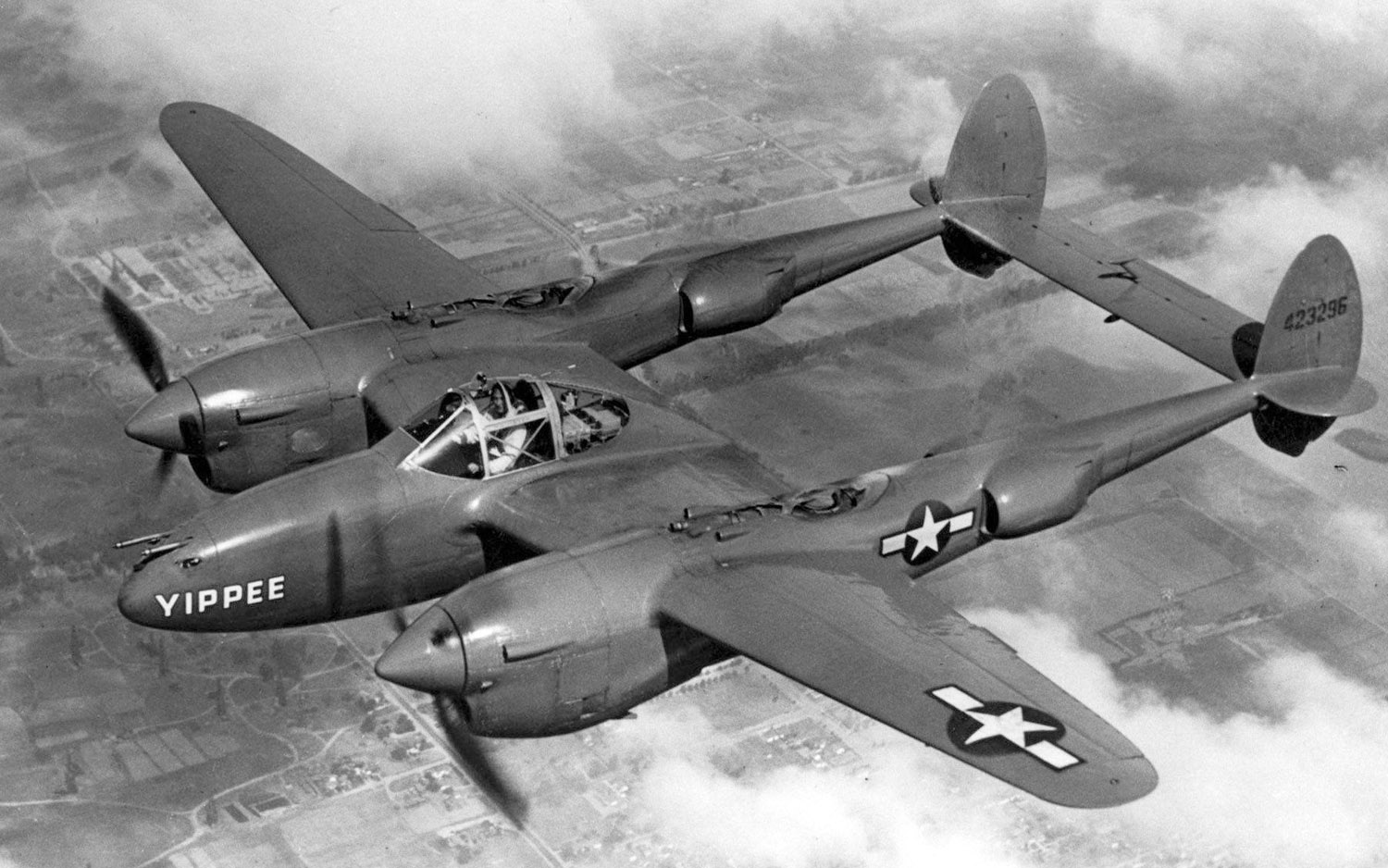 Lockeed P-38 Lightning (USAF Museum Photo Archive)
The two-hour, 600-mile outbound journey over water utilized a flight plan Mitchell had devised. The trip featured five legs, each marked by a turn that was designed to keep the formation on course, on schedule and yet maintain a distance of at least 25 miles from the coastline of nearby Japanese-controlled islands.
The group would fly at a low altitude of just 30 feet above the ocean to avoid detection by Japanese radar and maintain complete radio silence the entire way. The end goal was to intercept Yamamoto’s flight group, which included six Mitsubishi Zero fighter escorts — a fact conveniently included in the cracked message — in midair 10 miles west of Bougainville Island.
Based on Yamamoto’s scheduled arrival time of 10 — the admiral was a widely known stickler for punctuality — Mitchell’s calculations took into account distance, airspeed and other variable factors that would impact not only Yamamoto’s flight but also his own, to set a time of 9:35 for the planned interception.
Mitchell’s navigational arsenal included a U.S. Navy compass, which he insisted on having installed in his cockpit, a Swiss watch, an altimeter and his plane’s speedometer.
The timing of the two-hour flight was almost spot-on, although it is said the American flyers did arrive a bit early — at 9:34.
A dogfight ensued but, in the end, the mission was a brilliant success despite the cost of one American plane and its pilot.
Mitchell and the other aviators who executed it received great acclaim and commendations, including the Navy Cross.
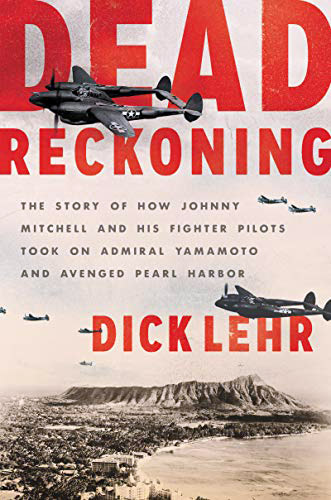
The internet is brimming with detailed information about the mission, but the 2020 book, “Dead Reckoning,” by Dick Lehr, paints it more from Mitchell’s perspective, as well as offering a deep look into the Enid native’s life through personal letters written by the pilot.
Mitchell’s son said his dad always gave credit to God for the mission’s success.
“It was an unbelievable mission, and it was a power greater than my father who made it all happen,” Billy said.
In his opening prayer at Tuesday’s ceremony, Barron Caulfield also alluded to that point: “As quoted by at least one source, he [Mitchell] said the success of that mission had to be an act of God, and we acknowledge that.”
— * —
According to the official presidential citation, Mitchell was awarded the Navy Cross for “extraordinary heroism,” “outstanding professional skill and daring courage,” and for exhibiting “brilliant leadership and valiant devotion to duty under extremely adverse conditions” on April 18.
By the time he retired from the military as a full colonel in 1958, Mitchell had flown 240 combat missions and held several commands, receiving 22 awards and decorations.
Mitchell died Nov. 15, 1995, in San Anselmo, California. He was 81.
Billy, who served his country in the U.S. Navy, said his father “was a very humble man, very quiet, very simple, very intelligent, very humble,” and did not often speak of his military exploits.
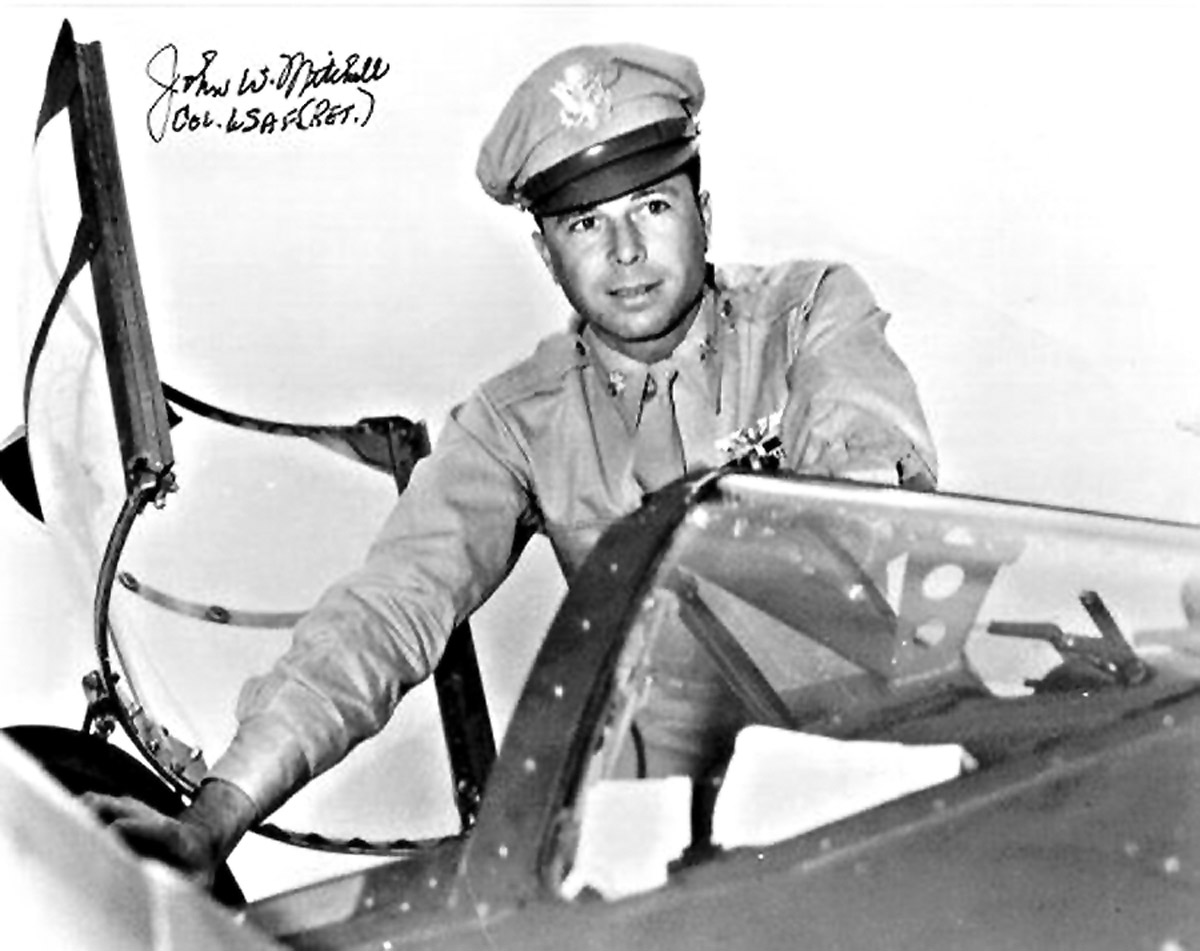 John William Mitchell of Enid (Public Domain)
“He shared some things with us, with his boy when I would ask him, but not much,” noted Billy. “People that he played tennis with later on after he retired, they didn’t even know that he had done any of this stuff, because he didn’t talk about it. He just kept it quiet.
“But he was just this amazing person that grew up here in Enid and went on to command Air Force bases. He commanded several Air Force bases. When he retired, they moved back to California. He was at Hamilton Air Force Base there in the Bay area for a while. That’s where I grew up.”
Billy’s last words at Tuesday’s ceremony were, “They don’t make them like that anymore.”
— * —
When Mitchell went off to college and afterward joined the military, he did not spend extended periods of time in Tallahatchie County. He came for occasional visits with family. Still, he never forgot the connection.
Through his dad’s will, Billy inherited 2 acres of Mitchell family land at Enid. He owns it still, nearly three decades later.
 John William Mitchell (Public Domain)
In 2022, Enid-area residents David Howard and Don Dalrymple launched the campaign to erect a marker in Mitchell’s honor, raising the $2,200 and change to pay for its manufacture and delivery. State Archives and History officials first had to verify the facts before authorizing the project.
For future protection of the Mitchell memorial, Howard deeded Billy a 25-by-10 plot of land on which the double-sided marker stands.
It is one of seven state-sanctioned historical markers in Tallahatchie County and the first dedicated to a single individual.
Two denote the founding of Tallahatchie County; one marks the historic New Hope Presbyterian Church; another stands outside the Tallahatchie County Courthouse in Sumner, site of the 1955 Emmett Till murder trial; and others signify the communities of Cascilla and Paynes.